What's in this guide
- At a glance
- What "nut-free" means
- Reading labels
- Best snacks
- Trusted brands
- Lunchbox system
- Birthday treats
- FAQ
You get the note from school. "Our classroom is nut-free." And suddenly a snack you've been packing for years is no longer an option. If that sounds familiar, you're not alone. According to FARE (Food Allergy Research & Education), approximately 1 in 13 children in the U.S. has a food allergy, which works out to roughly 2 kids per average classroom.1 Nut-free policies exist to protect those kids, and once you know what to look for, building a school-safe lunchbox gets a lot easier.
This guide covers everything parents actually need: how to decode labels, which nut free snacks for school hold up in a lunchbox, how to handle classrooms with multiple allergen restrictions, and what to bring for birthday celebrations. We'll also walk through a simple system for building a balanced box without the weekly guesswork.
- Peanuts and tree nuts are different things, and school policies vary on which they ban. Know your school's specific rule before you shop.
- "Nut-free" is not an FDA-regulated label claim. The language on the package ("may contain," "processed in a shared facility," "manufactured in a nut-free facility") signals different levels of risk.
- Many kids with nut allergies also have other allergies. Snacks that are free from multiple allergens simultaneously save a lot of headaches.
- A simple four-part lunchbox formula (protein + fruit or veg + grain + fun treat) works even within tight allergy constraints.
- Birthday treats need a plan. A dedicated section below covers packaged, store-bought, and homemade options you can send in with confidence.
At a glance
A quick reference for the most common questions parents have at the start of the school year.
| Question | Short answer |
|---|---|
| What do schools usually ban? | Peanuts, tree nuts, or both (ask your school's specific policy) |
| Are peanuts a tree nut? | No. Peanuts are legumes. A child may be allergic to one but not the other. |
| What does "may contain nuts" mean? | Possible cross-contact during manufacturing. Not an ingredient, but a real risk for severe allergies. |
| Is "nut-free" regulated by the FDA? | No. It's a voluntary claim. Verify with the manufacturer for severe allergies. |
| How many allergens does the FDA recognize? | 9 (as of January 2023): milk, eggs, fish, shellfish, tree nuts, peanuts, wheat, soybeans, and sesame |
| What's a good lunchbox formula? | Protein + fruit or veg + grain/cracker + one fun treat |
Understanding "Nut-Free": What Schools Actually Mean
Peanut-free vs. tree nut-free vs. both
Peanuts are legumes, not tree nuts. They're botanically closer to beans and lentils than to almonds or cashews. Tree nuts are a separate category that includes almonds, cashews, walnuts, pecans, pistachios, and several others. A child can be allergic to peanuts without being allergic to tree nuts, and vice versa, though co-allergies do happen.2
This distinction matters when you're shopping. A snack labeled "peanut-free" may still contain cashews or almonds. A snack labeled "tree nut-free" may still contain peanuts. If you're not sure what your child's classroom restricts, ask before you stock up.
Whole-school bans vs. classroom-only policies
Some schools operate a campus-wide nut-free policy. Others restrict nuts only in specific classrooms where a child with a severe allergy is enrolled. The rules can also change year to year as student rosters change.
The practical move is to contact your child's teacher or school nurse at the start of each school year and ask two questions directly: which allergens does this classroom restrict, and is there a written approved snack list? Many schools distribute exactly this kind of list. If yours does, keep it somewhere visible in the kitchen. It saves a lot of last-minute label squinting at 7 a.m.
FARE reports that food allergies affect roughly 1 in 13 children, and peanut is among the most common childhood food allergies and a leading trigger of anaphylaxis in school-age kids, which is why so many schools have formalized policies around it.1
How to Read Snack Labels for Nut Allergens
The Big 9 allergens (including sesame)
As of January 1, 2023, the FDA recognizes nine major food allergens that must be declared on food labels: milk, eggs, fish, shellfish, tree nuts, peanuts, wheat, soybeans, and sesame.3 Sesame was added by the FASTER Act of 2021 and is the newest addition to this list. Some parents who've been managing allergies for years may not have seen it on older packaging, so it's worth a fresh look at familiar products.
For a child with multiple food allergies, these nine categories are the starting checklist every time you pick up a new package.
"May contain" vs. "processed in a shared facility" vs. "nut-free facility"
This is where label reading gets genuinely confusing, and most snack packaging doesn't make it easy. Here's what each phrase actually means in plain language.
"May contain peanuts" or "may contain tree nuts" is an advisory statement. It means there's a possibility of cross-contact during manufacturing. The nuts are not intentional ingredients, but the product was made on equipment or in a facility that also handles them. For children with severe or anaphylactic-level allergies, these statements represent real risk and are typically a reason to avoid the product.
"Processed in a facility that also processes peanuts/tree nuts" is a facility-level disclosure. It means the manufacturing plant handles nut-containing products somewhere on site, even if the specific line your snack came off doesn't. The level of risk depends on the manufacturer's protocols for cleaning and segregating production.
"Manufactured in a nut-free facility" is the strongest voluntary claim. It means the entire facility does not process nuts. However, and this is important: the FDA does not regulate the term "nut-free" on packaging.4 Any brand can use it without meeting a defined federal standard. For families managing severe allergies, the best approach is to look for products with third-party allergen certification or to contact the manufacturer directly to ask about their facility protocols before relying on this claim.
The Best Nut-Free Snacks for School Lunchboxes
Fresh and whole food options
Fresh foods are often the easiest to send in safely because they don't require label-reading, and the options below are all reliable go-tos.
Fruit travels well and kids actually eat it. Clementines are a lunchbox favorite because they're self-contained and easy to peel. Grapes, apple slices (with a squeeze of lemon to slow browning), and berries in a small container all work. A banana is the zero-prep option on a rushed morning.
Cheese sticks and cubes add protein without any nut risk. Most plain dairy cheese is naturally allergen-free outside of milk, making them a safe protein anchor for classrooms that allow dairy. Skip these if you're in a dairy-free classroom (more on that below).
Vegetables with dip can work, but check your dip carefully. Hummus is a common lunchbox dip, but it's made with tahini, which is sesame paste. With sesame now classified as a major allergen, hummus is off the table for sesame-allergic classrooms and requires label scrutiny for everyone else.
Applesauce pouches are a consistent hit with younger kids. They're mess-free, self-contained, and most plain varieties contain only apples and water.
Hard-boiled eggs are a protein-dense option, but skip them if you're packing for an egg-free classroom.
Packaged snacks that are school-safe
Popcorn is one of the most naturally allergy-friendly snack foods available. Plain air-popped popcorn contains one ingredient. Flavored varieties need a label check for dairy, butter flavoring, and cross-contact advisories, but a good certified option handles those concerns easily. Popcorn also holds up well without refrigeration, which makes it practical for warm lunchboxes.
Rice cakes are another inherently simple snack. Plain varieties are typically free from the major eight allergens, though flavored versions vary. A plain rice cake with sunflower seed butter (confirmed nut-free on the label) adds protein for classrooms that allow it.
Crackers are a lunchbox staple, but not all of them are school-safe. Many contain wheat, dairy, or cross-contact warnings. Look for brands that specifically produce their crackers in an allergen-controlled environment.
Nut-free granola bars require the most label scrutiny of any packaged snack in this category. Granola is a fruit-and-grain product at its core, but most mainstream brands add nuts, oats that share lines with wheat, or dairy coatings. Certified nut-free granola bars exist and are worth keeping on your regular rotation, especially because they're easy to throw in a bag without any additional packaging.
Chickpea puffs have become a popular alternative to cheese puffs. Most are gluten-free and dairy-free by nature, though individual brands vary. Check for sesame and tree nut cross-contact advisories.
Fruit snacks and gummies read as allergen-free at first glance, but some contain gelatin, natural flavors derived from allergens, or cross-contact warnings. A quick label scan covers this.
Animal crackers are a classic and most commercial versions are free from peanuts and tree nuts. Check for wheat and dairy if those are concerns in your child's classroom.
Snacks that work for multiple allergens (nut-free plus dairy-free or gluten-free)
Some classrooms restrict more than one allergen simultaneously. A nut-free and dairy-free classroom is a common combination. Gluten-free requirements show up too, particularly when a child with celiac disease is in the room.
This is where many parents get stuck, because eliminating two or three allergen categories at once cuts through a surprisingly large portion of standard packaged snacks.
A few reliable multi-allergen-free options: plain popcorn (Top 9 allergen-free varieties specifically), rice-based snacks, fruit pouches, plain rice cakes, and products specifically formulated to be free from all nine major allergens. For this last category, Safe + Fair's granola and popcorn are formulated to be Top 9 allergen-free, which makes them a practical starting point when you're trying to satisfy multiple restrictions at once. You can also shop by allergy directly on the site to filter by exactly what you need.
The intersection of multiple food allergies is common. FARE notes that many children with one food allergy have additional co-existing allergies, which is why single-allergen-free claims often aren't enough for real-world lunchbox planning.1
Trusted Nut-Free Snack Brands
Safe + Fair
Safe + Fair was founded by two fathers whose children have food allergies. The mission behind the brand is straightforward: make snacks that are genuinely safe for food-allergic families and price them fairly so they're accessible, not just available to parents who can afford a specialty markup. That's what "Safe + Fair" actually means, safe for the tens of millions of food-allergic people in the U.S., and fairly priced for everyone.
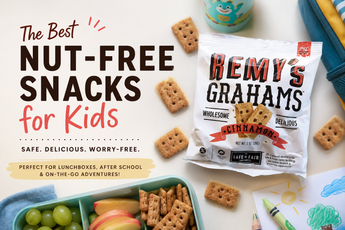
Safe + Fair's granola and popcorn are formulated to be Top 9 Allergen-Free, Gluten-Free, Vegan and Plant-Based, Non-GMO, Kosher, and Whole Grain, with no preservatives, no artificial ingredients, and no high-fructose corn syrup. Remy's Grahams, the third line, are nut-free (free of tree nuts and peanuts) rather than Top 9 Allergen-Free, so check the label if you need them free of other allergens.
One important note, because it matters for severe allergies: the Top 9 Allergen-Free claim applies to the granola and popcorn. Remy's Grahams are nut-free (tree nut and peanut free), not Top 9. Allergen profiles differ by product line. The brand's FAQ lists which allergens are present in each product line's manufacturing facility, since the lines are produced separately. If your child has an anaphylactic-level allergy, check the specific facility FAQ for the product you're considering rather than relying on the recipe claim alone.
Safe + Fair also donates 3% of proceeds to the Sean N. Parker Center for Allergy and Asthma Research at Stanford University, so every bag does a little extra work. Learn more about that partnership on the S+F & Stanford page.
Other brands parents rely on
A couple of other allergy-friendly brands worth knowing, both in categories Safe + Fair doesn't make:
Enjoy Life Foods is the most established name in allergy-friendly snacking and labels its products as free from 14 common allergens. Their cookies, chocolate bars, and soft-baked snacks are widely available and well-regarded in the allergy community.
That's It fruit bars contain just two ingredients (two fruits), come individually wrapped, and are naturally free from the major allergens, which makes them a simple, reliable lunchbox option.
For any brand with a child who has a severe allergy, the safest move is to confirm facility claims directly with the manufacturer before adding it to the regular rotation. Labels can change when formulations change, so a periodic recheck of your go-to products is worthwhile.
Building a Balanced Nut-Free Lunchbox: A Simple System
The hardest part of packing a nut-free lunchbox is finding snacks that add up to something balanced rather than just a pile of crackers.
A simple four-part formula takes the guesswork out of it: protein + fruit or vegetable + grain or cracker + one fun treat. You don't need to hit every food group at every snack. But for a full packed lunch, this formula produces something balanced without a lot of mental math.
A few combinations that work in practice:
Combo 1 (dairy-friendly): Cheese stick + apple slices + plain rice cakes + a popcorn bag. The cheese handles protein, the apple handles produce, the rice cakes are the grain, and the popcorn is the treat.
Combo 2 (dairy-free, multi-allergen): Sunflower seed butter on a rice cake + clementine + chickpea puffs + a certified nut-free granola bar. Everything in this box can be Top 9 allergen-free with the right brand choices.
Combo 3 (fruit-forward, younger kids): Applesauce pouch + carrot sticks + animal crackers + fruit snacks. Quick to pack, easy to eat, no utensils needed.
A note on storage: Popcorn and rice-based snacks hold up fine in a warm lunchbox with no ice pack. Fresh fruit, cheese, and anything with a filling or coating generally does better with an ice pack or an insulated container. Granola bars are stable at room temperature but can get soft in heat if they contain chocolate or a drizzle. Keep the temperature-sensitive items together in one section so they stay cool longer.
Nut-Free Birthday Treats and Classroom Celebrations
Birthday treats for school require a different level of planning than everyday snacks. You're bringing something for an entire class of kids, which means unknown allergy combinations, and you're usually doing it in advance without knowing exactly which classrooms are restrictive about homemade items.
Before you bring anything, ask the teacher two things: is there a class allergy list you should know about, and does the school allow homemade treats? Some schools require commercially packaged items only for classroom celebrations. Others welcome homemade items if they're labeled with ingredients. Know the rule before you bake.
Packaged options that work well for birthday celebrations:
Individually wrapped snacks are the most practical format for classroom treats because kids can read the labels themselves (or parents checking backpacks can), and there's no portioning required. Look for variety packs of individually wrapped popcorn bags, snack-size granola bars certified as Top 9 allergen-free, or fruit snacks in individual pouches. Safe + Fair's Top 9 Allergen-Free popcorn bags are sized well for this kind of celebration; their Remy's Grahams work for nut-free classrooms (they're tree nut and peanut free, so check the label for any other restrictions).
Store-bought baked goods:
If your school allows it and there's a bakery near you that uses dedicated allergen-free equipment, a batch of cupcakes can work. Call ahead and ask specifically about their facility practices. Many grocery store bakery departments cannot guarantee a nut-free environment, which means a certified packaged alternative is the safer call for mixed-allergy classrooms.
Simple homemade ideas (where allowed):
Rice crispy treats made with certified gluten-free, allergen-free rice cereal and vegan butter are a crowd-pleaser and naturally free from most allergens. Fruit kabobs on skewers are festive, no-bake, and universally safe. Popcorn bags made with plain air-popped popcorn and a tie-on label listing ingredients travel well and kids love them.
Whatever you bring, write out the full ingredient list and have it available. A teacher fielding questions from parents of allergic kids will appreciate it, and it signals that you took the time to think this through.
For more allergen-friendly celebration ideas, the Safe Celebrations guide on our blog has a full breakdown worth bookmarking before the next class party rolls around.
If you're building out your school-year snack rotation, Safe + Fair's nut-free collection brings granola, popcorn, and Remy's Grahams together in one place. The granola and popcorn are Top 9 Allergen-Free; Remy's is nut-free (tree nut and peanut free), a handy shortcut to have on hand when the September lunchbox scramble hits.
Frequently Asked Questions
What snacks are good for nut allergies?
The most reliably safe snacks for nut allergies are foods that are naturally nut-free (fresh fruit, plain popcorn, rice cakes, cheese, vegetables) or packaged products specifically formulated and manufactured to avoid nut cross-contact. Look for products labeled "manufactured in a nut-free facility" and, for severe allergies, verify that claim directly with the manufacturer or look for third-party allergen certification. The snack list in this guide covers both fresh and packaged options organized by category.
What snack brands are nut-free?
Several brands specialize in allergy-friendly snacking. Safe + Fair's granola and popcorn are formulated to be Top 9 Allergen-Free (which includes both peanuts and tree nuts), while its Remy's Grahams are nut-free (tree nut and peanut free); the product FAQ lists allergen information by product line. Enjoy Life Foods labels its products as free from 14 common allergens, and That's It fruit bars contain just two ingredients and are naturally free from the major allergens. Always verify current labels before purchasing, since formulations can change.
What kids' snacks are made in a nut-free facility?
The claim "made in a nut-free facility" is a voluntary one and not regulated by the FDA, so it requires verification rather than assumption. For Safe + Fair specifically, facility allergen information is listed by product line in the brand FAQ. For other brands, the manufacturer's website or customer service line is the best source for accurate, current facility information. Third-party allergen certifications, where they exist, provide the most independent confirmation.
Are sunflower seeds nut-free?
Yes. Sunflower seeds are seeds, not nuts, and are not classified as a tree nut or peanut under FDA allergen labeling. Most children with peanut or tree nut allergies can safely eat sunflower seeds, though cross-contact is possible if seeds are processed on shared equipment with nuts. Check packaging for advisory statements. Sunflower seed butter is a popular nut-free alternative to peanut butter for school lunches in classrooms that allow it.
Is hummus nut-free?
Traditional hummus is made with tahini, which is ground sesame paste. Sesame became a major FDA-recognized allergen as of January 1, 2023. For a classroom with sesame restrictions, standard hummus is not an appropriate option. Some brands produce tahini-free hummus, but ingredient and cross-contact labels should be reviewed carefully. For classrooms that restrict sesame specifically, a plain guacamole or a sunflower seed-based dip is a safer alternative.
What are nut-free school-safe birthday treats?
The most practical options for classroom birthday treats are individually wrapped, commercially packaged snacks with clear ingredient labeling. Individually wrapped popcorn bags, snack-size allergen-free granola bars, and single-serve fruit pouches work well. Where homemade items are allowed by the school, rice crispy treats made with allergen-free ingredients, fruit kabobs, and plain popcorn bags tied with an ingredient label are all reliable choices. Always ask the teacher about the class allergy list before bringing anything, and have a full ingredient list available on the day.
What's the difference between a peanut-free and a tree nut-free school policy?
A peanut-free policy restricts only peanuts (a legume). A tree nut-free policy restricts almonds, cashews, walnuts, pecans, pistachios, and other tree nuts. Some schools enforce both restrictions simultaneously. The distinction matters when choosing snacks because a product can be peanut-free but still contain almonds, or tree nut-free but still contain peanuts. Ask your school which specific nuts are restricted before buying in bulk.
What should I do if I'm not sure whether a snack is safe for my child's classroom?
Start by confirming the classroom's specific allergy policy in writing from the teacher or school nurse. Then check the product label for both ingredient listings and cross-contact advisory statements. For any product you're uncertain about, contact the manufacturer directly. They're required to know their facility practices and can confirm whether advisory statements reflect a real risk for your child's specific allergy. When in doubt, defaulting to a product with third-party allergen certification or a brand that lists facility-level allergen information publicly gives you more to work with than a label alone.
Sources
- FARE (Food Allergy Research & Education), Food Allergy Facts and Statistics for the U.S., FARE, 2023. View
- American Academy of Allergy, Asthma & Immunology, Peanut Allergy, AAAAI, 2023. View
- U.S. Food and Drug Administration, The FASTER Act: Sesame Is the Ninth Major Food Allergen, FDA, 2021. View
- FARE (Food Allergy Research & Education), How to Read a Food Label (advisory statements like "may contain" are voluntary, and "nut-free" / "free-from" claims are not FDA-regulated). View